






“No one in college wrestling is taking st*roids.”
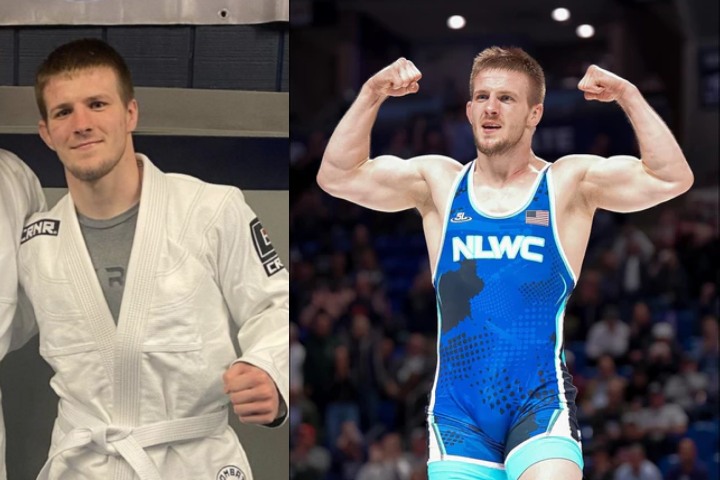
Three-time NCAA Champion Jason Nolf, widely regarded as one of the most technically proficient American wrestlers of his generation, has officially announced his retirement from wrestling at the age of 28. The announcement came during a recent episode of the Athletes Ocean podcast, where Nolf shared that after more than two decades in the sport, he’s ready to pivot toward business ventures and competition in Brazilian Jiu-Jitsu (BJJ).
“I’ve been wrestling for 22 years now… it’s been a really big part of my life,” Nolf said. “I just want to officially announce that I’m retiring. I’m done wrestling.”
While his decision may come as a surprise—especially since he was still in the running for the U.S. Olympic Team—Nolf explained that his next chapter will center around his company, Athletes Ocean, and a move to Austin, Texas, a hotspot for both entrepreneurship and high-level Jiu-Jitsu.
“Austin is a big Jiu-Jitsu hub,” he noted, “and I want to continue to compete in Jiu-Jitsu… we can grow the Jiu-Jitsu side of Ocean as well.”
But in addition to revealing his future plans, Nolf made a particularly bold statement during a separate interview:
“No one in college wrestling is taking steroids.”
No one in college wrestling is taking steroids
— Jason Nolf (@jasonnolf) March 25, 2025
A powerful claim—especially in an era where PED (performance-enhancing drug) use is a shadow over nearly every major sport.
Is College Wrestling Really Clean?
Nolf’s assertion raises eyebrows. Wrestling is one of the most physically demanding sports in the world, requiring extreme strength, cardio, and recovery. Yet he maintains that collegiate wrestling is steroid-free. Is this true?
While USADA (U.S. Anti-Doping Agency) does conduct testing in Olympic-level wrestling, collegiate wrestling is governed by the NCAA, which handles drug testing through its own protocols. Testing in NCAA wrestling does exist, but it’s relatively limited in scope compared to pro sports or Olympic programs. Athletes are subject to random drug testing, especially at national championships, but day-to-day testing is rare at the college level unless athletes are in the NCAA’s year-round testing pool.
Who Has Been Caught?
Despite the limited testing, some athletes have been caught using banned substances. A few notable doping cases in the past two decades include:
-
Travis Rutt (2011) – Former Wisconsin wrestler tested positive for a banned stimulant.
-
Darrion Caldwell (early 2000s) – While not officially suspended by NCAA, Caldwell has spoken about PED culture and the pressure of performance.
-
Various Olympic hopefuls – Several American wrestlers transitioning from college to Olympic competition have failed USADA tests, indicating that PED use may emerge more frequently at the post-collegiate level.
While these cases are rare, they raise the question: is wrestling truly clean, or is the testing not rigorous enough to catch what’s going on?
The Contrast: BJJ and Rampant Steroid Use
Compared to wrestling, Brazilian Jiu-Jitsu has an open secret: steroid use is widespread.
Unlike NCAA wrestling, there is little to no standardized testing in BJJ at most levels—even among elite athletes. Promotions like ADCC, IBJJF, and Fight to Win have experimented with limited testing, but enforcement is sparse, and consequences are inconsistent.
“In BJJ, you’re often more surprised to find out someone isn’t on something,” quipped one black belt competitor anonymously.
The BJJ community has long accepted PED use as part of the game, especially in professional no-gi events where physical attributes like strength and explosiveness play a major role.
As Nolf transitions into BJJ, he’ll be entering a world with far fewer restrictions on PEDs—a stark contrast from the relatively drug-tested environment of college wrestling.
A New Chapter in Austin: Jiu-Jitsu and Ocean Elite
Despite the murky PED waters in BJJ, Jason Nolf is diving into the sport with purpose.
“I want to continue to compete in Jiu-Jitsu,” he said. “And we can grow the Jiu-Jitsu side of (Athletes) Ocean as well.”
He’s not just joining the scene—he’s building within it. Nolf plans to start a wrestling club, Ocean Elite, in Round Rock, Texas, helping develop the next generation of grapplers by blending wrestling with modern submission grappling.
This aligns with a growing trend of elite American wrestlers crossing into BJJ, bringing with them world-class takedowns, work ethic, and a strong anti-steroid culture—at least initially.
Is Nolf Right?
Jason Nolf’s statement that “no one in college wrestling is taking steroids” is likely idealistic, but not necessarily false—at least within the high-character, tightly coached environment of top programs like Penn State.
However, limited NCAA testing and the physical demands of the sport leave plenty of room for skepticism.
Compared to BJJ, where PED use is visible, rampant, and largely unregulated, wrestling still maintains a cleaner image—but perhaps because it has more structure and less spotlight on doping, not because abuse doesn’t happen.
As Nolf steps into BJJ, his clean-cut ethos, Olympic-level wrestling, and leadership ambitions could be a refreshing influence on a sport that often blurs the ethical lines.
Sloth Jiu-Jitsu: you can be slow and unathletic and still kick butt in Jiu-Jitsu.

BJJEE
Source link
#college #wrestling #stroids